
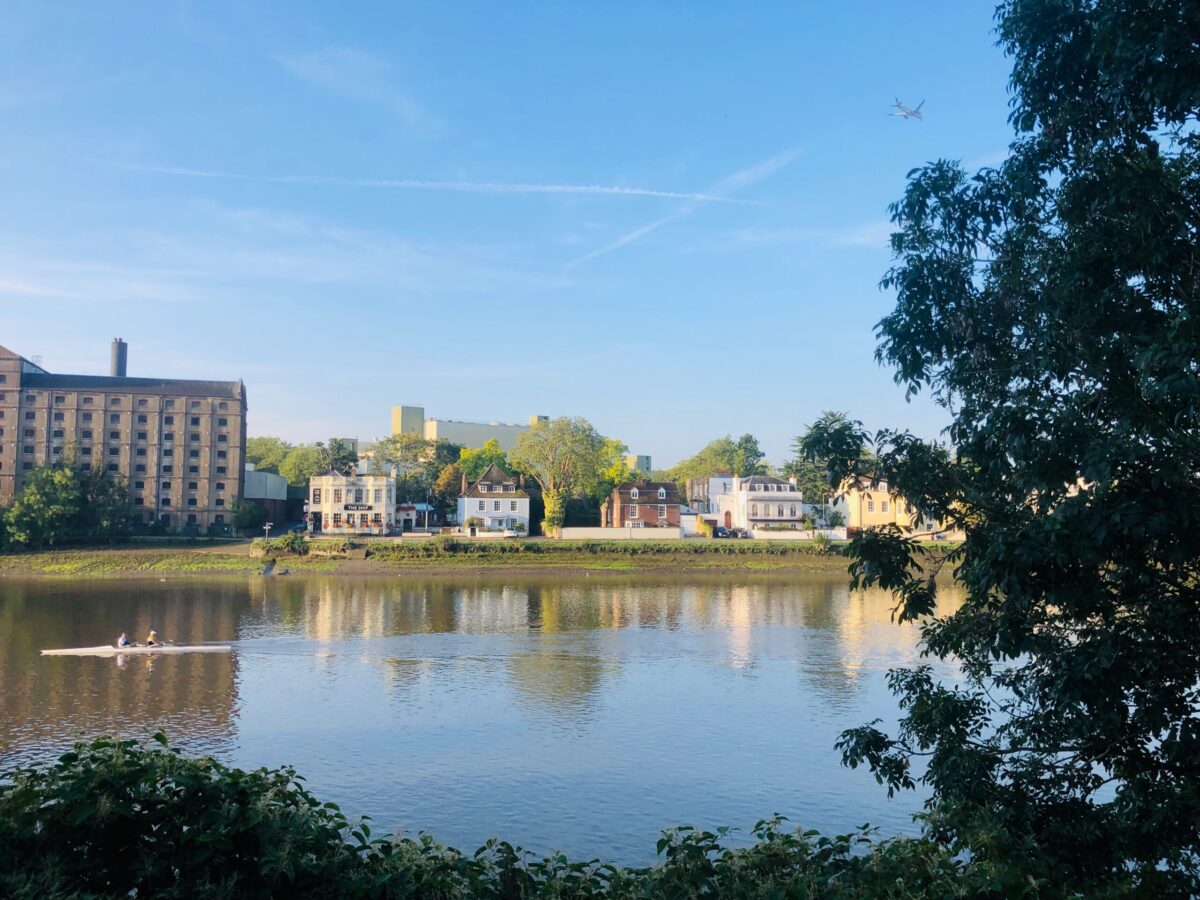
One of the many arguments we made to the Mayor in objecting to the latest plans was the damage and harm the proposals would do to the beautiful riverside location of Mortlake. We were delighted in his summing up at the Hearing, that the Mayor recognised that “important riverside views “were at risk He also said the development would “adversely affect the Arcadian and open character of the area generally.” We were very pleased that the Mayor used the term Arcadian as we believe that this stretch of river should be formally designated as part of the Arcadian Thames route. But what does Arcadian really mean in relation to Mortlake and its riverside history?
Helen Deaton, from Barnes and Mortlake History Society explains…
The stretch of the river that flows past Mortlake’s Thames Bank from the Ship Lane draw dock, westward towards Richmond, marks the start of the Arcadian Thames. Leigh’s Panorama of the Thames painted in 1829 shows this area.
It was during the 18th century that grand houses with gardens and woodlands were built along sections of the Thames in the southwestern outskirts of London. This river landscape, which has allowed people to escape the noise and pollution of the city for centuries, has come to be known as the Arcadian Thames. But along Thames Bank, many houses are even older and are of particular historic and architectural importance.
The village of Mortlake grew up along this stretch of the Thames and close to its Manor House. This was a country retreat for the Archbishops of Canterbury for some 500 hundred years, and itself overlooked the river, giving easy access to the royal palaces of Whitehall and Hampton Court. The people living in the grand houses along Thames Bank that had been built from the 15th century also used the river for transportation and for pleasure.
Of these fashionable houses Leyden House, built in the 15th century, now with its 18th century façade, is the oldest domestic building still standing in Mortlake. It has been home to colonial administrators, city merchants, a poet and a botanist. Riverside House with its substantial conservatory was an impressive 16th century home. It was converted into five houses in the 20th century, now called Varsity Row, but it still retains its original external construction. Cromwell House, dating back to the late 15th century, stood away from the river. However, its extensive, landscaped gardens stretched down to the Thames which could be viewed from its elaborate gazebo.
Thames Bank is also home to The Ship which has served beer to the local populace since at least the 18th century. Next to The Ship is Thames Cottage, another 17th century building which was once an ale house. Thames Bank House was built around 1730 and was the home of Sir James Eyre, Chief Justice of the Common Pleas. Tudor Lodge, with its brick façade, was originally built around 1690.
Leyden House, Tudor Lodge, Riverside House, Thames Cottage and Thames Bank House are now Grade II Listed properties, the new buildings of Parliament Mews and additions to Riverside House are of Townscape Merit and the whole area lies within Conservation Area 33. Any new development that is built south of Thames Bank should therefore be proportionate and designed in sympathy with these existing buildings. They must not be overwhelmed by modern structures and the historic view of Thames Bank from the north bank should remain unspoiled.
Because of their aesthetic qualities, the houses along Thames Bank enhance the tow path which is so popular with local families and visitors from around the world, and shows Mortlake off to great acclaim on Boat Race Day. Thames Bank has an intimate relationship with the Thames (never more so than at high tide) – pleasure boats, rowers and scullers, herons and swans, narrow boats and yachts can all be seen along Mortlake’s Arcadian riverside today.
Helen Deaton, Barnes & Mortlake History Society (Twitter, Facebook)